
The CDO Influence Problem
Opinion: How to build tacit authority

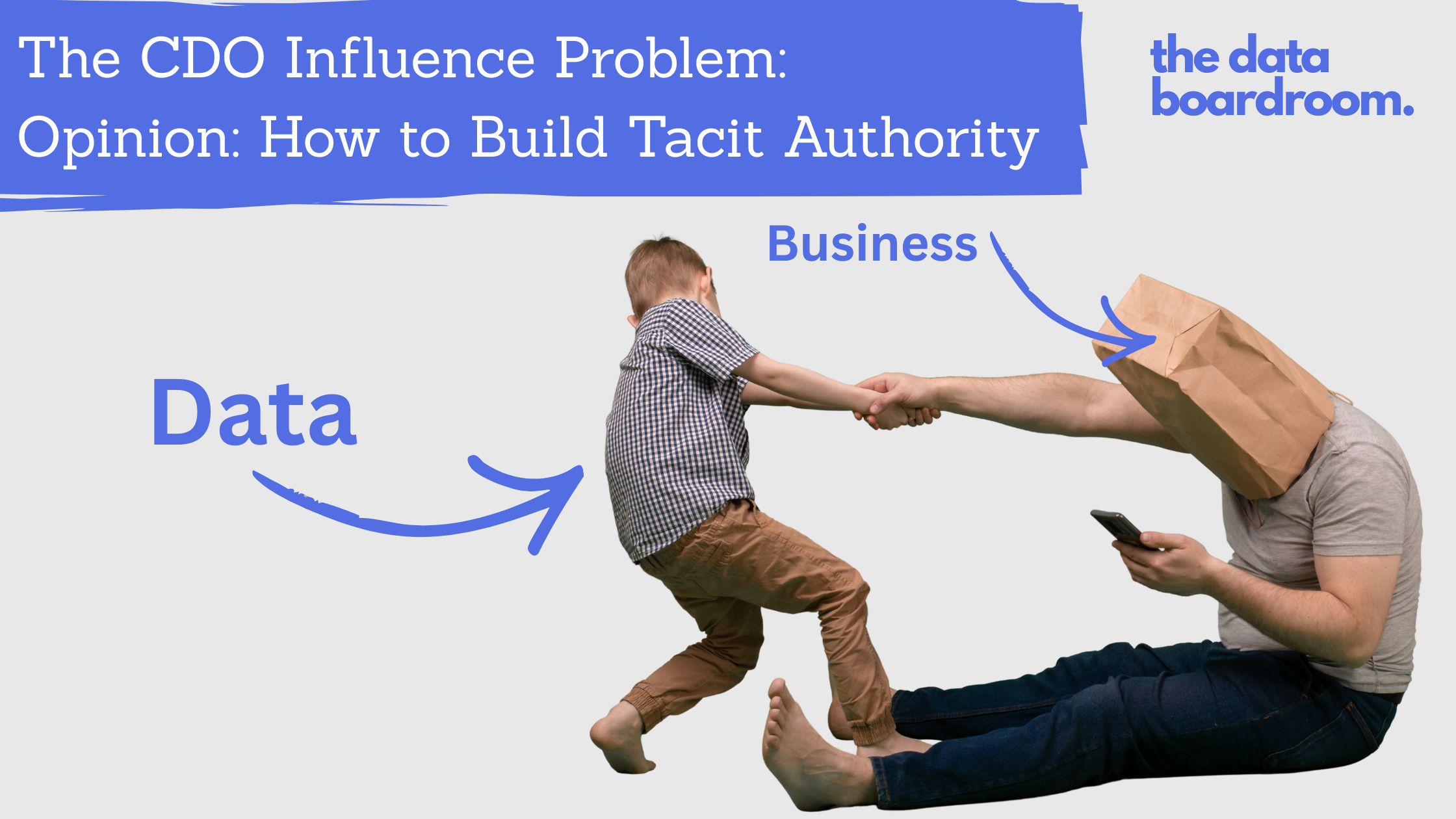
This week, I’m on my trusty soapbox, to tackle a common problem facing many data leaders.
The issue of influence. Specifically, influencing without authority. This is a concern for many of us, even data Chief Data Officers, despite their titles.
This piece builds on the primer I wrote last week, where I urged data leaders to adopt an asset mindset. My solution stems from this.
If you want to go back and look at that, the link is below.
Got the badge, but no bite
If you spend time in data leadership circles, you’ll know the conversation. Chief Data Officers, who are experienced, capable, C-suite in title, feel the frustration of not being able to get things done. The badge is there. The authority isn’t.
The trope of the inefective CDO is somewhat lazy, but it appears with comic regularity, LinkedIn, especially, isn’t short of advice about navigating the CDO challenge of influencing without authority.
From my reading, most of this well-meaning advice covers some familiar bases. The sort of advice handed out to any leader.
Build relationships. Communicate value better. Find an executive sponsor. Get some quick wins on the board. Learn to tell better stories.
As I said, the advice tends to come from a sensible place. Much from real experience, of CDOs, who have become successful C-suite navigators. And it isn’t wrong. Not exactly.
But I fear it is solving the wrong problem. Those offering it are describing, accurately, how to survive in a role where authority is absent. What they are not describing is how to make that absence irrelevant.
That distinction matters, because the two approaches lead to very different places.
Navigating the problem versus eliminating it
The conventional CDO influence playbook is essentially a set of coping mechanisms - ways to get things done despite a structural deficit. They work, up to a point. But a CDO who has cultivated excellent relationships and learned to communicate in business language is still dependent on the goodwill of others to get anything done. That position has to be renewed constantly. It doesn’t always survive a change of CEO, a reorganisation, or a hostile budget cycle.
The more useful question is whether it’s possible to build something more durable. Not influence borrowed from relationships, but authority generated from knowledge - the kind that doesn’t require permission, because the people around the table actually need what you know.
The glorified IT manager problem
A significant number of CDOs spend the majority of their time on governance, data quality, data platforms, AI experiments and the mechanics of data management. These are necessary responsibilities. But they are difficult to translate into a case for strategic partnership.
When a CDO leads with techncial knowledge alone, there is little wonder that most boards hear “infrastructure.” Then, think “cost.”
I suspect, this is partly why average CDO tenures tend to be short. Not because the role is unimportant, but because too many CDOs frame themselves in ways that invite the organisation to treat data as an operational function rather than a strategic one.
When good advice leads you astray
One of the most notorious tips is to focus on quick wins. While well-intentioned guidance, it can compound the problem. The logic is understandable - demonstrate value early, build credibility, show the organisation what data can do. Most of us have followed it.
But consider what it signals. Can you think of another executive appointment where the standard advice is to rack up quick wins before the organisation loses patience? Nobody tells a new CFO to find three easy financial fixes in the first ninety days. The fact that this advice exists for CDOs, and is accepted so readily, says something uncomfortable about how the role is perceived, and sadly how some CDOs have come to perceive it themselves.
A confession
I know this territory well.
Early in one CDO role, I joined a major real estate business and identified what looked like the pressing problem: the reporting was a mess. So I rationalised the reports, built a single view, tidied the dashboards. People were grateful. It felt like progress.
It wasn’t wrong. But it wasn’t what mattered most.
What the organisation actually needed was a more predictive understanding of its lease portfolio. Which tenants were at risk of failing? Which might trade through difficulty? In a challenging retail environment, seeing tenant distress coming is the difference between protecting income and reacting to losses. I got there eventually, but after spending time and political capital on dashboards that looked nice, but didn’t move the needle.
As I explored in last week’s primer on data asset economics, the window to build strategically valuable datasets isn’t always open indefinitely. Time spent on the wrong thing can cost you.
What I later realised, was in those early months I lacked a clear enough map of how data connected to the organisation’s real commercial pressures. If I had listened to the business properly, and built that enterprise map, even at a high-level, my priorities would have been clearer and early impact more meaningful.
The map that generates authority
What every data leader needs, before almost anything else, is a coherent picture of how data connects the organisation: what assets exist, where they sit, how they relate to the commercial engine, where the risks lie, and where value is waiting to be unlocked.
This is not glamorous work, and while it isn’t a quick win itself,it can be achieved well within the classic 90 day window.
What it will do, is provide the case for focusing on the right priorities.
When you genuinely understand the business-data landscape of your organisation better than anyone else in the room, the dynamic shifts. You are no longer someone asking to be listened to. You are someone whose knowledge others need in order to make good decisions.
That is a fundamentally different position - one that doesn’t depend on goodwill or evaporate when the political climate changes. It is, in the truest sense, tacit authority.
Think about what a Chief Economist does in a major bank or government institution. No line authority. No operational control. But significant influence, because they hold the most rigorous view of what is happening and what the trade-offs look like. Nobody ignores the Chief Economist because nobody can afford to. Their authority comes from what they know, not what they’ve been granted. That is the model a CDO should be building toward.
Again last week’s primer on data asset economics is relevant here. Its lessons, such as the portfolio effect of combined datasets, the positional value of longitudinal data, and the erosion of competitive advantage over time, are the building blocks of a commercial vocabulary that lets a data leader function as an economic advisor rather than a technical function head.
A CDO fluent in the economic vocabulary of data will have a different conversation from one who leads with platforms and governance frameworks.
This kind of knowledge doesn’t require a mandate. It creates one.
Where to focus instead
🗺️ Start with the map: Understand the territory before trying to influence anything. What are the organisation’s most critical data assets? Where are the gaps between what the business needs to know and what it currently can? The CDO who does this properly finds that priorities become self-evident and the C-suite conversation shifts from “trust me, data matters” to “here is specifically what is at stake.”
🫨 Find the question that keeps the CEO awake. Every organisation has one or two problems that senior leadership worries about but can’t fully see. The CDO who becomes the person with the clearest data-driven view of those problems will never struggle to get a hearing. In the landlord example, it was tenant distress. Wherever it is in your organisation, find it and build your case from there.
💰 Build the economic case for your assets. Most CDOs cannot say, with any precision, what their organisation’s key data assets are actually worth. Developing that view (even roughly) reframes data from a cost to be managed into an asset to be invested in, and gives the CDO a commercial vocabulary the rest of the C-suite respects.
💎 Value first, governance second. Governance is necessary but a poor flagship. Leading with it tells the boardroom that the CDO’s primary concern is process and compliance. Do the governance work- but frame the agenda around value creation, and let governance be the infrastructure that enables it.
🔔 Choose your moment, not your meetings. The CDO who shows up with the right intelligence when a real decision is being made (a new market, a restructure, a competitive threat) accumulates authority faster than one who attends every meeting but rarely shapes any of them.
The authority you earn is more durable than the authority you’re given
Experts giving the conventional influence advice are not wrong. They are describing, from hard experience, what it takes to operate in an environment where authority hasn’t been granted.
But the goal should be to make that environment unnecessary. Authority granted by an org chart can be ignored, eroded, or not renewed when leadership changes. The influence that comes from being the person who holds the clearest picture of what the organisation’s data is worth and where its value lies is considerably harder to take away.
It accumulates. It survives reorganisations.
The CDOs who last, and who genuinely move organisations, are rarely the ones who fought hardest for a bigger remit. They are the ones who built an intelligence advantage that made them impossible to ignore. Then they got a bigger remit.
That is a different ambition from learning to influence without authority. It is the ambition to not need to.
Until next time,
James
As ever, if you have any comments or would like me to explore a data leadership theme that has been keeping you awake at night, just get in touch.