The 'quick win' trap
When good advice becomes bad strategy

I’m back. The real world has been busy, as it occasionally insists on being.
A quick note on how I operate. I only write when I have something worth saying. I know that breaks every rule about content, but I refuse to fill your inbox with weekly gubbins just for the sake of it. You can decide whether that’s admirable or just lazy.
This week I have another uncomfortable question for you.
Why are data leaders the only executives who feel the need to audition for a job they’ve already been given?
Forever proving ourselves
The CFO doesn’t spend their first ninety days proving finance deserves to exist. The CMO doesn’t rush out a flurry of minor campaign tweaks to justify the marketing budget. They walk in, read the room, and get on with it.
Data leaders are different. And there is one bit of advice we’ve all heard a million times, that underlines this problem.
“Find a quick win.”
It sounds sensible. It often isn’t. And the damage it does - to careers, to data functions, and to the credibility of the people following it - is something we need to talk about.
Every CDO playbook says something similar. Get on the board fast. Show early impact. Build credibility before the honeymoon period ends. The advice is well-intentioned, but I’m not sure anyone who has actually succeeded in data leadership, at least in the long term, would hand out such advice.
My strong opinion? Most new data leaders who follow this advice end up busier than ever, with less authority than when they started.
I know, because I followed this advice too
Early in one role, I inherited a dashboard project that had taken on a life of its own. An IT director had decided the business needed a comprehensive performance reporting suite. Metrics everywhere. Beautifully designed. The kind of thing that looks transformative in a board presentation and is quietly ignored otherwise.
It wasn’t my idea. But, keen to just produce something (anything), I got pulled in, and we delivered it. The business said thank you. And then carried on exactly as before.
The dashboard wasn’t a bust. It just didn’t solve anything that actually mattered. It was a monument to looking busy — which, in fairness, is what it was designed to be.
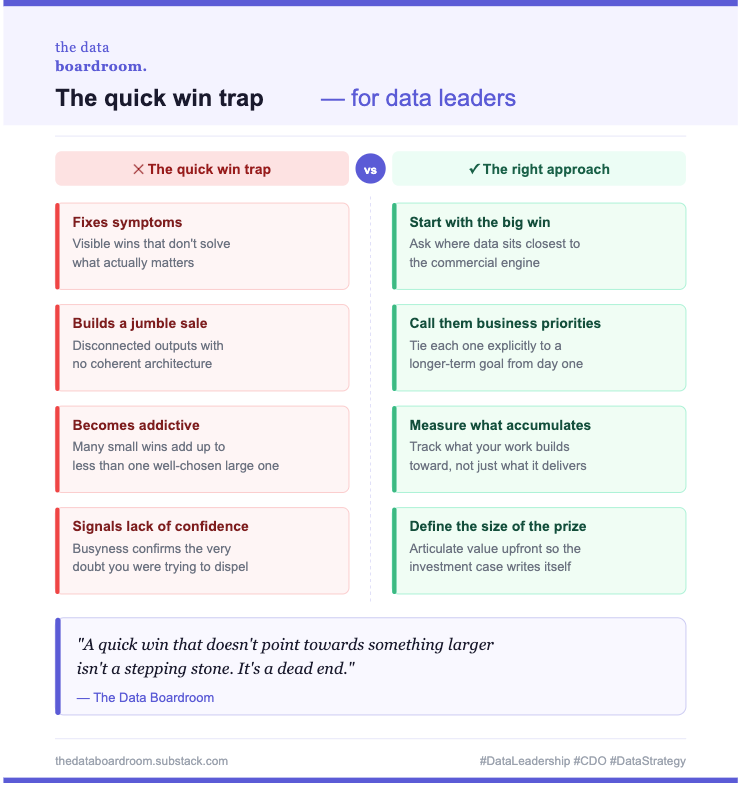
This is the first problem with quick wins. They often fix the symptom rather than the disease. You patch something visible, declare victory, and the underlying problem quietly festers. Six months later you’re back in the same room, explaining why the data function still isn’t delivering what the business needs. The win wasn’t a stepping stone. It was a distraction.
The second problem is structural. A string of disconnected quick wins leaves you with a data estate that looks like a jumble sale - lots of individual items, nothing that coheres. That matters enormously when the business eventually wants to do something ambitious, whether that’s serious AI adoption, enterprise analytics, or anything that requires trustworthy data at scale. You can’t build a cathedral out of quick wins.
The third problem is the urge to ‘do a quick win’ can be fantastically addictive. Many data leaders don’t just do one quick win. They do many. Yet, multiple quick wins, accumulated over time, typically deliver less combined value than a single well-chosen large one. Each individual win looks fine in isolation. Collectively they add up to a data function that’s been permanently busy and never quite transformative.
Leadership notices. Not immediately, but eventually. Investment cases get harder. Appetite diminishes. The data function starts to feel like a luxury rather than a capability. The CDO leaves before their first two years are up - it happens a lot.
There is a fourth problem, and this one makes me squirm. Chasing quick wins is self-undermining. It signals a lack of confidence in the value of the role itself. No other function operates this way. Busyness is not the same as impact. And in trying so hard to look valuable, you risk confirming the very doubt you were trying to dispel.
So what should you do instead?
The answer, in my experience, is insultingly simple. Understand how the business makes its money and work backwards from there.
Once I realised that my business would benefit from me solving a structural (a.ka. a hard problem), rather than an isolated quick win, I was able to focus our finite resources on the real prize.
In commercial property (where I had my dashboard issue), the business made its money from rent. That one fact told me everything I needed to know about where data could have real impact. Not dashboards. Not performance metrics. Lease sustainability - understanding which tenants were likely to survive, which were failing, and what that meant for the asset’s long-term income.
Nobody thought it was possible. The data was messy, the methodology didn’t exist, and frankly the business wasn’t sure it wanted to hear the answer. We invested in research, brought in a specialist, and built something that had never been done before.
When we took it to the CFO, the conversation was different. Not “well done, interesting stuff.” It was a multi-million pound upside at a single asset, with a clear view of which tenants to manage out and how to go into those negotiations with the right information.
The business didn’t just understand it. They used it.
That work funded the next investment, because I could define the size of the prize before I asked for the money. I would never have got there on the back of a performative quick win.
So before you chase the next quick win, it is worth thinking about these three things:
Start with the big win in mind, not the quick one. The first question isn’t “what can we deliver fast?” It’s “where does data sit closest to the commercial engine?” Everything else follows from that. A quick win that doesn’t point towards something larger isn’t a stepping stone. It’s a dead end. Avoid.
Maybe stop calling them quick wins. Call them business priorities. The language matters. Quick wins are things you deliver to keep leadership happy. Business priorities are things the organisation actually needs. One is about managing perception. The other is about creating value. Define them upfront, tie each one explicitly to a longer-term goal, and resist the pull to keep adding more just to show the needle is moving. A single well-chosen priority that builds towards something bigger is worth more than a dozen disconnected wins that add up to nothing.
Measure what accumulates, not what completes. Leadership loses faith in data not because individual projects fail, but because the wins never seem to compound into anything transformative. Track what your work is building towards, not just what it has delivered. If you can’t draw a clear line between today’s priority and tomorrow’s capability, you have a problem.
Quick wins aren’t inherently bad. But you need to ask yourself whether yours are building towards something, or substituting for it. A ladder takes you somewhere. If that quick win is a rung on the way (or better, enough rungs to get you to the next level), then go for it.
Just don’t let the urge to prove yourself, get in the way of actually doing the job you were hired to do.
Until next time,
James
✂️ Cut-out and keep